

Services

Seven areas of engineering work, described in full

For each service below, STEP AHEAD SOURCING LTD sets out its purpose, the typical scope of an engagement, how delivery is approached and what you receive at the end. Services are combined where a project needs more than one.

Server racks illuminated in a data centre aisle

Overview

How these services fit together

Most engagements draw on several of these areas at once. A new web application involves software development, interface work, a cloud environment and quality assurance. A modernisation project usually begins with technical consulting before any code is written.

  • 01

    Software development

  • 02

    Web application development

  • 03

    Cloud solutions

  • 04

    Systems integration

  • 05

    Automation

  • 06

    Quality assurance and testing

  • 07

    Technical consulting

Service 01

Software development

Design and implementation of backend services, domain logic, APIs and internal tools.

Purpose

To turn a described business process into a working system whose behaviour is defined, tested and documented, and which can be extended by engineers who join later.

Typical scope

Requirements analysis, domain modelling, data model and schema design, service and API implementation, background and scheduled processing, migration of existing logic, and extension or stabilisation of an inherited codebase.

Delivery approach

The scope is written down before implementation begins, including assumptions and open questions. Work then proceeds in reviewable increments, each with tests where they add value, deployed to an environment you can inspect. Design decisions are recorded alongside the code.

Expected deliverables

  • Source code in your repository, with commit history
  • Automated tests covering the agreed behaviour
  • Database schema and migration scripts
  • Build, run and deployment instructions
  • Written notes on architecture and key decisions
Service 02

Web application development

Responsive, accessible browser applications built on a consistent component system.

Purpose

To give users an interface that is fast, readable and predictable on any screen size, and to give your team a front-end codebase where a new screen can be added without re-inventing the design.

Typical scope

Information architecture, component library, page and flow implementation, form handling and validation, state management, integration with backend APIs, accessibility work, and performance tuning of loading and rendering.

Delivery approach

Layouts are designed for narrow screens first and expanded to tablet and desktop. Semantic markup, heading hierarchy, colour contrast, descriptive alternative text and reduced-motion support are treated as requirements. Images are sized, and content below the fold is lazy loaded.

Expected deliverables

  • Front-end source code and reusable component library
  • Responsive layouts verified on mobile, tablet and desktop
  • Accessibility notes covering markup, contrast and motion
  • Build pipeline and deployment configuration
  • Documentation of components and their intended use

Service 03

Cloud solutions

Reproducible environments, deployment pipelines, observability and cost-aware sizing.

Purpose

To make environments something that can be created, compared and rebuilt deliberately, rather than machines that were configured once by hand and can no longer be reproduced.

Typical scope

Environment definition as code, deployment pipelines, configuration and secret handling, container and service setup, logging and metrics, backup and restore procedures, and migration from manually managed servers to managed services.

Delivery approach

Staging mirrors production closely enough to be meaningful. Migrations are rehearsed in a non-production environment with a documented path back before production is touched. Resource sizing is reviewed against actual usage and cost rather than left at defaults.

Expected deliverables

  • Infrastructure definitions stored as code
  • Automated deployment pipeline for each environment
  • Logging, metrics and alerting configuration
  • Tested backup and restore procedure
  • Runbook describing routine and recovery operations

Service 04

Systems integration

Reliable data exchange between systems that were not designed to work together.

Purpose

To make separate systems behave consistently, so that a record created in one place appears correctly in another without manual re-entry or periodic reconciliation by hand.

Typical scope

Interface analysis, field-level mapping, transport and scheduling design, transformation logic, error and retry handling, monitoring of transfers, and documentation of the contract between each pair of systems.

Delivery approach

Every interface gets a documented shape, documented error responses and a named owner. Processing is made idempotent so retries are safe. Failures record what failed, with which payload and at what time; silent failure is treated as a defect.

Expected deliverables

  • Integration services or jobs with source code
  • Documented field mappings and interface contracts
  • Retry, error and reconciliation handling
  • Monitoring and transfer logs
  • Operational guide for diagnosing failed transfers

Service 05

Automation

Replacing repeated manual steps with scheduled and event-driven processes.

Purpose

To remove the recurring manual work that consumes staff time and introduces inconsistency, while keeping a record of every action the automation performs.

Typical scope

Process analysis, identification of the steps worth automating, implementation of scheduled jobs and event-driven handlers, document and report generation, notifications, and controlled roll-out beside the existing manual process.

Delivery approach

The current process is documented before it is automated, so that the automation reproduces the intended outcome rather than an accident of habit. Every run leaves an audit trail, and automation is introduced in parallel with the manual process until results match.

Expected deliverables

  • Automated jobs or handlers with source code
  • Schedule, trigger and configuration definitions
  • Run logs and audit trail of changes made
  • Failure handling and notification rules
  • Written description of the automated process

Service 06

Quality assurance and testing

Test strategy and implementation chosen for value rather than for a coverage number.

Purpose

To make releases predictable by ensuring that important behaviour is verified automatically and that regressions are detected before users encounter them.

Typical scope

Test strategy definition, unit and integration test implementation, a selected set of end-to-end flows, regression checks against previously reported defects, performance sanity testing, and exploratory review of new behaviour.

Delivery approach

Tests are written where they protect something that matters. Integration tests exercise real databases and real boundaries. A small, deliberately chosen end-to-end suite covers flows that must never break, and exploratory testing is done by someone who did not implement the change.

Expected deliverables

  • Documented test strategy and its rationale
  • Automated test suites at the agreed levels
  • Test execution in the continuous integration pipeline
  • Defect reports with reproduction steps
  • Release checklist covering regression and sanity checks

Service 07

Technical consulting

Independent review of architecture, codebases and technical plans.

Purpose

To give decision-makers a clear, written technical assessment before committing budget — whether the question is how to proceed, whether to rebuild or extend, or why an existing system is difficult to change.

Typical scope

Architecture and codebase review, dependency and technology assessment, evaluation of build-versus-buy options, technical due diligence on a planned direction, and a prioritised remediation plan with estimated effort.

Delivery approach

Findings are based on reading the actual system and talking to the people who operate it, not on a generic checklist. Each finding is stated with its evidence, its practical consequence and a recommended action, ordered by impact rather than by ease.

Expected deliverables

  • Written assessment with findings and evidence
  • Prioritised recommendations with indicative effort
  • Architecture or dependency diagrams where useful
  • Risk summary written for non-specialist readers
  • A walkthrough session covering questions on the report

Engagement notes

What applies to every service

Scope is written before work starts, with assumptions and open questions named explicitly. Delivery happens in reviewable increments. Source code, configuration and documentation are handed over so that your team or another supplier can continue the work.

Estimates state their uncertainty. Where a number depends on an unknown, the unknown is named and a way to resolve it is proposed rather than buried in a contingency figure.

Enquiries are handled by email at claudiealley475@gmail.com, shown here as plain text.

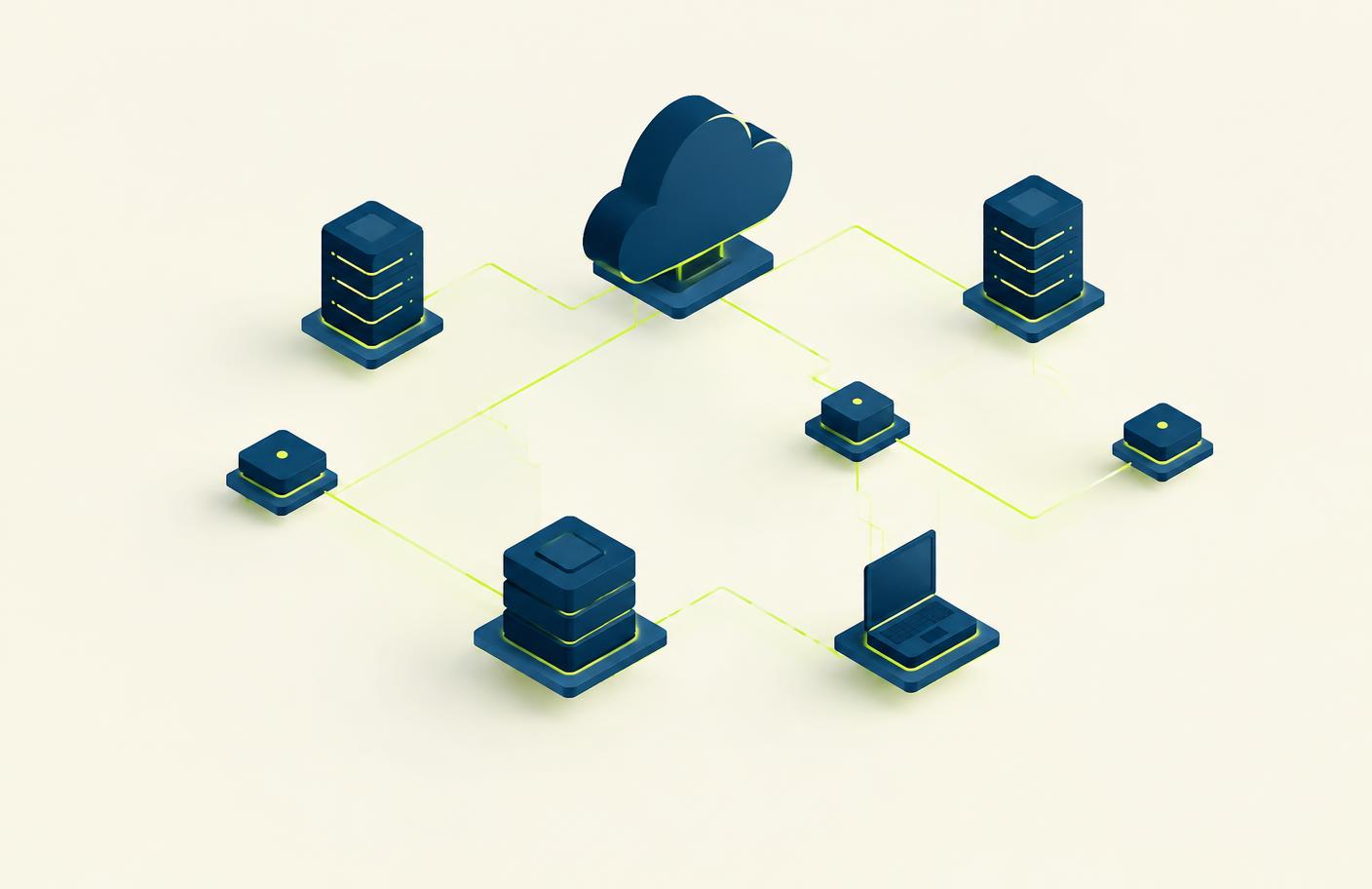
Isometric diagram of cloud services linked to servers and a laptop